
Raleigh Historical Directory Collections
Raleigh city directories are held in several forms, and each one answers a slightly different question. The Wake Public Libraries catalog record groups the local run under call number 917.5655 RALEIGH. It names R.L. Polk & Co. and Hill Directory Co. among contributors, while its aliases also point to Branson, Maloney, Wills-Smith, cross-reference, and criss-cross volumes. A catalog entry is proof of a listed holding, not proof that each year in the gap is available.
| Collection | Years | Where Held | Access |
|---|---|---|---|
| Wake cataloged Raleigh directories | 1880-81, 1887, 1891, 1896-97, 1899-1900, 1907-08 | Wake Public Libraries catalog, call no. 917.5655 RALEIGH | Confirm item availability and handling in the catalog |
| Chataigne's Raleigh City Directory | 1875-76 | DigitalNC | Free full text, PDF, and text search |
| Raleigh N.C. Directory | 1907-08 | DigitalNC record and Internet Archive scan | Online record |
| NARA city-directory finding aid | 1929-31 | National Archives list | Coverage lead, not a digitized volume |
Begin with the volume nearest the event date. Record its publication year, the catalog call number or scan URL, and the page number. That small citation trail makes it possible to return to the same listing when a later source uses a different spelling or street form.
Raleigh Directory Runs by Cataloged Year
The verified Wake holdings are selective. The catalog lists 1880-81, 1887, 1891, 1896-97, 1899-1900, and 1907-08. It identifies the 1891 item with Branson, notes Maloney around 1896, and identifies volume 4 in the 1899-1900 run. Those details help distinguish similar citations, especially when a family name appears in a library note, probate file, or newspaper notice.
The Wake Public Libraries Raleigh City Directory catalog record shown here is the starting point for confirming a listed edition and its call number.
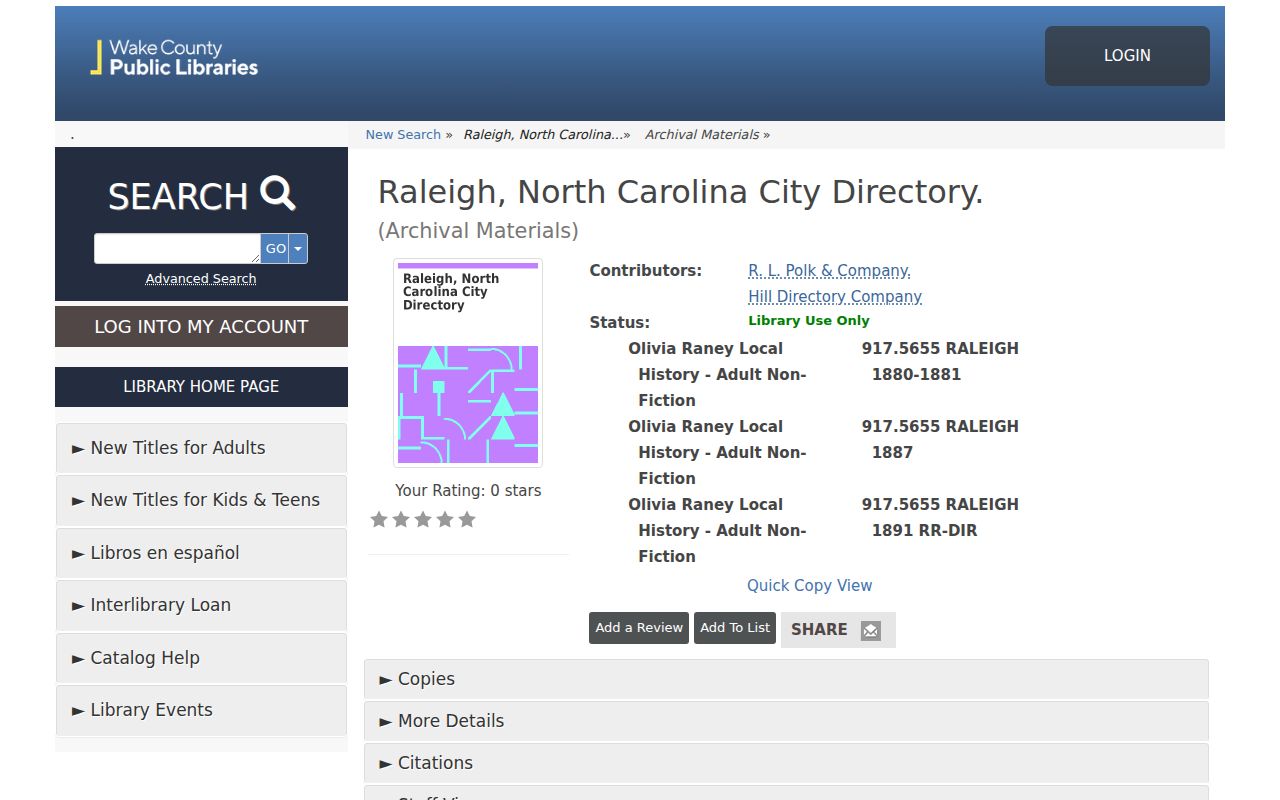
Use the catalog record to verify the item before requesting it, then cite the physical volume or scan page actually consulted.
Do not turn the listed dates into a continuous series. A person may be present in one Raleigh city directory, absent in the next cataloged volume, and still remain in the same neighborhood. Publication lag, initials, a business address, a move, or an omission can explain the difference. Preserve the exact year searched and call a no-result a no-result in that volume only.
Note: The cataloged run is a set of verified leads, so check the current catalog entry before planning a visit or requesting an item.
Raleigh Directory Scans Online
DigitalNC's city-directory collection makes J.H. Chataigne's 1875-76 Raleigh volume available as a 234-page scan with full text, PDF, and text-search access. That combination is useful when a surname has a likely spelling variant. Search is only a starting point, though. Open the result page and read the surrounding entries, headings, and the volume's own abbreviation key.
The separate 1907-08 Raleigh directory record is tied to Wake County and an Internet Archive scan. Cite the scan title page and the page where the listing appears, rather than treating a search-result snippet as the record. A source date matters because the listing documents a published snapshot, not a claim about a person's present location.
Raleigh Directories in the 1930 Lead
The National Archives 1930 city-directory list identifies Raleigh coverage for 1929-31. It is a finding aid. It does not mean that NARA has supplied a searchable Raleigh directory on that page. Use the years as a lead, then identify the repository or scan that actually holds the desired volume.
This distinction is important for family history. A finding aid can tell you that a time window is worth pursuing, while a catalog record, microfilm reel, or digitized page supplies the item that can be cited. Record the two sources separately, along with the search date and the spelling used.
Reading a Raleigh Directory Entry
An entry can connect a name to an address and an occupation or business label at the time the volume was prepared. It can also use initials, abbreviations, or a cross-reference instead of a full family account. Read the full entry and its nearby headings before assigning a role. The inventory below describes common elements supported by the Raleigh collection research, not a promise that every volume prints every field.
| Name | The spelling, initials, or household-head form printed by that volume. |
|---|---|
| Address | A dated street address or business address, which may need a historic street-name check. |
| Occupation or business | A work or business description that can separate two people with the same name. |
| Household marker | A notation or cross-reference that may connect a householder to another listing. |
| Cross-reference | A pointer to another name or address entry, especially useful in cross-reference volumes. |
- Criss-cross directory
- A directory arranged by street or address rather than only by name. Wake's catalog uses Wills-Smith and cross-reference terms among its Raleigh directory aliases.
- Householder index
- An index organized around the named household head. It can be a route into an address, but it does not prove every person who lived there.
- Abbreviation key
- The publisher's explanation of shortened terms and symbols. Read it before expanding an occupation or relationship mark.
- Publication snapshot
- A listing tied to the book's publication period. It should be dated and compared with other records, not used as a current-residence claim.
Read the entry as a compact, dated lead. An occupation or business label may distinguish two people with the same name, while an address may point to a map, notice, or deed search. Neither field turns a listing into a complete family roster. Preserve the page image or page citation before making a comparison with another Raleigh source.
Raleigh Directory Clues in Notices
When a listing changes, dated notices can explain why. The Raleigh Register catalog lists microfilm for 1823-30 and 1840-68, while the Raleigh Register and NC State Gazette notices source covers marriage and death notices from 1846-67. Wake's N&O Index catalog also lists particular printed and microfilm runs. Check the precise run before expecting a year to be indexed.
For the physical setting, use a dated map. NCSU's Sanborn collection describes Raleigh fire-insurance map access, though access may require library credentials. Sanborn maps show street arrangement, building footprint, and use. They do not name every resident, so they are context for a directory entry rather than an occupant list.
Note: Map symbols describe buildings and uses, not a named household, so retain a directory or notice citation alongside them.
Trace a Raleigh Directory Household
Use a name and a dated address together whenever possible. The most useful sequence moves from a directory listing to the nearest map and then to another dated source. The Wake catalog also identifies an Olivia Raney Local History Library 1870 census index with 20 reels of microfilm or fiche. Census indexes and directories use different formats, so compare the name, address wording, year, and source type instead of forcing an exact match.
- Start with the earliest confirmed Raleigh listing or an address from a family paper, and test initials and spelling variants.
- Search the nearest cataloged directory years and write down the printed name, address, occupation or business label, and every cross-reference.
- Use the directory year to check a map, newspaper index, or notice for a move, marriage, death, business change, or street-name variation.
- Compare the household with the relevant census-index lead, keeping the directory's publication date separate from the census date.
- End each trail with a repository citation: catalog call number, reel or scan, page, search terms, and the date checked.
A disappearance can mean a move, a death, a changed initial, a business-only listing, or no listing at all. It is not proof of any one event. For a later parcel trail, switch from the historical listing to the Raleigh street directory and its address-keyed records.
Raleigh Directories and Changing Borders
Raleigh's city label is time-dependent. A street can cross city limits, an ETJ, or a county line, and historic records may use a township or nearby post office rather than the municipal name used today. The Raleigh Map Gallery provides city-limit and annexation-history map context for reconciling those descriptions.
For an address that seems to vanish, follow the historical reconstruction chain: directory year, map or street name, parcel or lot, deed book and page, then permit or annexation layer. If an old directory lacks a house number, use a cross-reference, subdivision or lot map, and adjacent entries, then label the result as an inference. Do not silently convert a historic address into a modern one.
Raleigh Directory Gaps and Losses
Historical research needs a clear record of what did not survive. Raleigh's historic cemeteries page says City Cemetery records were destroyed in the municipal auditorium fire of October 25, 1930. The loss means an absent interment record may reflect destroyed records, burial elsewhere, or incomplete surviving material. It does not settle a family question by itself.
The same care applies to directories, newspaper reels, and catalog leads. Use the NC Archives or Wake catalog when an online scan ends, and preserve the collection, reel, box, or page reference. The NC Archives Raleigh search room is an in-person archival route; its posted rules require photo ID and place bags and coats outside the room in lockers.
Archive staff can help identify a collection, but a researcher still needs a specific citation. Bring the catalog lead, publication year, name variants, and address form. After inspecting an item, add the actual box, reel, map sheet, or page to the research log instead of citing only the repository's general landing page.
Note: Archive restrictions and catalog handling can change, so confirm current access requirements before an in-person visit.