
Finding Raleigh Resident Records
Raleigh does not keep one master roll of every resident. The useful route depends on whether you start with a name, an address, or an older date. For an address, the Wake County parcel record is a sound first stop because it supplies a situs address, parcel identifiers, ownership fields, and transfer references. For a current registration question, use the North Carolina Voter Search and preserve the date searched. For a past household, the Wake library catalog and digitized city directories are stronger than a modern index.
Each result has a limited role. A deed party may be a seller, lender, trustee, or grantee. A parcel owner may use a separate mailing address. A voter result is evidence of registration, not proof that someone is physically present. The Raleigh residents directory works best as a trail of dated, labeled records rather than a list that claims to settle identity or occupancy.
- Enter the street number and street name in the Wake real-estate search, omitting the street type when the field asks for a location.
- Record the REID or PIN, property location address, owner field, and transfer book and page without treating them as occupancy evidence.
- Use the voter lookup or county data route for a current registration lead, keeping protected fields out of notes.
- Search the Register of Deeds index by the recorded party, document type, date, or book and page to classify the instrument.
- For an earlier era, compare a dated directory entry with newspapers, maps, and the repository citation that supports it.
Note: Save the source URL, date checked, exact query, and record role before combining Raleigh results from different offices.
Raleigh Resident Record Custodians
Most Raleigh resident records are held outside city hall. Wake County Revenue maintains the real-estate search, the Wake County Register of Deeds maintains recorded land instruments and local vital-record routes, and the State Board of Elections supplies the statewide voter search framework. The City Clerk holds municipal actions, while city development records show work and approval context at an address. The Raleigh street directory follows the address chain in more detail.
Wake County Register of Deeds
300 S Salisbury St., Suite 1700
Raleigh, NC 27601
919-856-5460
Wake County Revenue
County parcel and tax records
Raleigh and Wake County, NC
919-856-5400
North Carolina State Board of Elections
State voter lookup and data routes
Wake County coverage
919-814-0700
Raleigh Address to Parcel Path
The Wake real-estate search is the key address bridge for Raleigh directory work. Its official field reference allows a location search with the street number and street name, such as “309 Calvin,” without the street type. It also supports owner, REID, and PIN searches. A partial or ambiguous location may return a street list, which is useful when a directional prefix or suffix has changed. The live portal says property information changes daily, so record the date beside any field copied into notes.
| Wake search field | How to use it | What to preserve |
|---|---|---|
| Location address | Use number and street name; omit the street type. | Situs address and the matched parcel. |
| Owner | Enter last name first for an individual, or a business name. | The displayed ownership role, not an occupancy claim. |
| REID | Use the property identifier when a prior search supplied it. | REID and the associated record date. |
| PIN | Use map, optional scale, block, and lot for map-based research. | Map reference and parcel context. |
Parcel cards may show the property location, owner mailing address, zoning, city, township, acreage, assessed values, and transfer details. Those labels matter. A mailing address can belong to an owner elsewhere, while a property location identifies land, not a person living there. Transfer book and page provide the next step into the recorded instrument.
Raleigh Records Need Map Context
Raleigh’s online mapping applications describe iMAPS as a city and county mapping partnership. The viewer accepts owner, address, PIN, REID, street, place-of-interest, and intersection searches. It helps reconcile a Raleigh postal label with city limits, ETJ, zoning, township, or other civic layers. It is not a survey, a deed, or proof that a named person currently occupies an address.
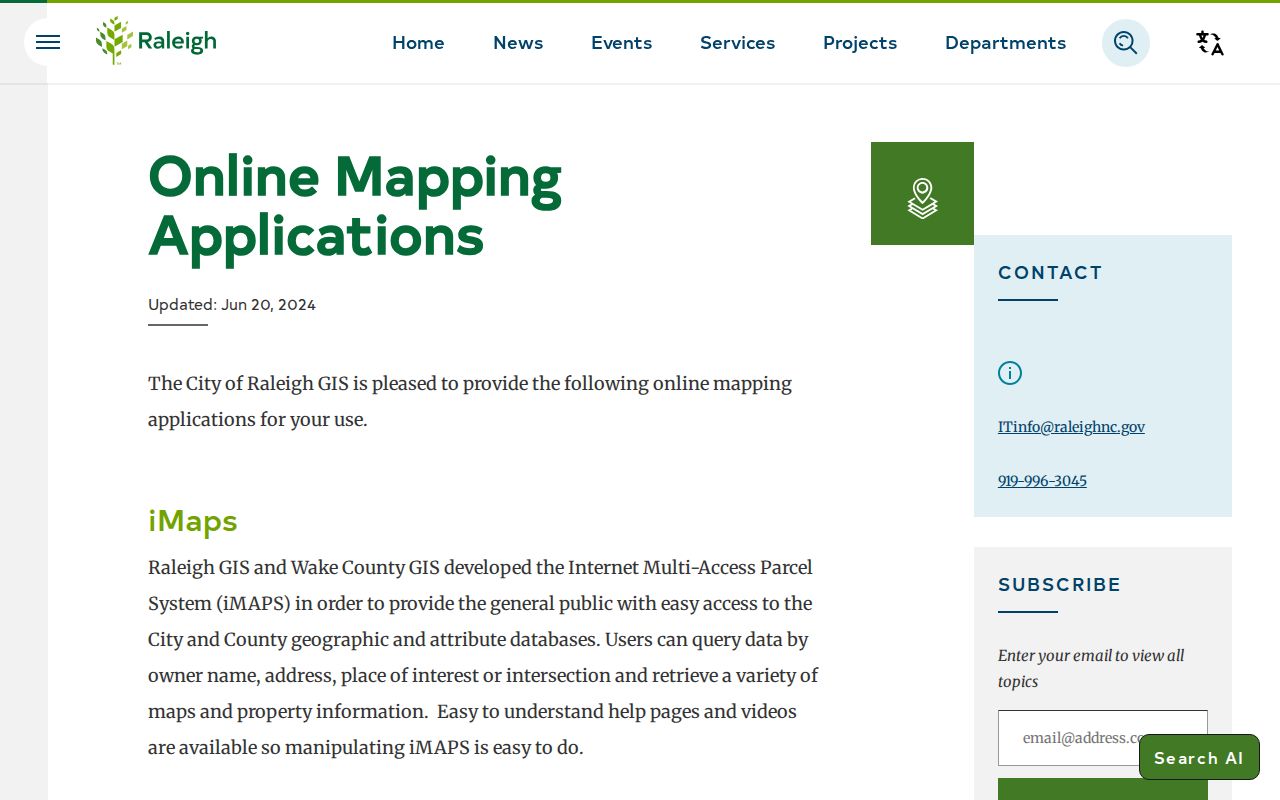
The city’s mapping-applications page is a useful starting point before moving into Wake parcel data or a recorded deed. Check the map’s source date and identify results, especially where the city boundary and a postal Raleigh address do not line up.
- Parcel
- A defined piece of land used in the county tax and map system.
- Situs address
- The property-location address assigned to the parcel; it is different from an owner mailing address.
- Index
- A searchable pointer to a record. It may not contain the full instrument or prove every fact in it.
- Criss-cross directory
- A reverse-style directory arranged to help connect an address with a dated listing.
Raleigh Deed Names Have Roles
The Wake County Consolidated Real Property Index searches grantor and grantee names, document type, date range, book, and page. Its legacy interface reports coverage from July 1785 through April 17, 2025, while the Register of Deeds directs newer work to its Land Records application. The index calls itself a library-card-catalog type tool. Treat it as a way to identify a document and its parties, then read the underlying record or request a certified copy when the legal description matters.
Grantor and grantee do not simply mean resident and owner. A grantor may be a seller, mortgage debtor, or a person granting another right. A grantee may be a buyer or the recipient of another recorded interest. Trustees, lenders, attorneys, businesses, estates, easements, maps, and releases can all create a name hit. Use the document type and recorded date before connecting a person to a Raleigh address.
Raleigh Voter Records Are Dated
North Carolina’s voter-search and downloadable registration data can help distinguish a current registration lead from a historic address clue. Under G.S. 163-82.10, public list fields can include a name, address subject to protection, party, precinct, district, age rather than date of birth, and voter history. The State Board also provides county and historical snapshots. A snapshot identifies the registration data at its stated time, not every ballot cast or a complete residential history.
Keep date of birth, Social Security information, driver-license numbers, submitted email, photo-ID material, and protected addresses out of a Raleigh residents directory search. A voter may use an Address Confidentiality Program or protective-order protection. When an address is protected, stop expanding the address trail and use the custodian’s process.
Current Raleigh Resident Directories
Current Raleigh directory research is a question of scope. Parcel data speaks to property and tax relationships. A voter result speaks to registration status at the time searched. eCourts reports a party role in a public case, and municipal development records show a project or approval relationship. The Raleigh resident lookup uses those separate signals to test one name without turning any single hit into a conclusion.
| Source | Who It Lists | Keeper | Access |
|---|---|---|---|
| Wake real-estate search | Parcel owners and property fields | Wake County Revenue | Public portal |
| Voter Search and data | Registered voters and statutory list fields | NC State Board of Elections | Lookup and data routes |
| ROD real-property index | Recorded-instrument parties | Wake County Register of Deeds | Public index; copies have rules |
| Raleigh development records | Permit and approval context | City of Raleigh | Portal and archive route |
| Neighborhood Registry | Registered group boundaries and contacts | City of Raleigh | Public directory and map |
Commercial people-finder products may combine public material, but their results can be stale, costly, and unclear about source date or record role. Official sources make it easier to see which office owns a field and when it was checked. That distinction is especially important for common names and out-of-date addresses.
Raleigh Names in Public Court Records
The NC eCourts Portal reached all 100 counties in October 2025, so Wake searches begin in the statewide system. Anonymous users can use Smart Search, hearing search, and judgment search. Advanced options can narrow a search by location, party name, case type, status, or filing range. A Wake case number can use county code 910, but a format example is only a search aid, not a person match.
A public result may list a case summary, party information, events, hearings, dispositions, or financial information when applicable. It does not make confidential material public, prove a party’s residence, or establish wrongdoing. Court terminals and the Wake clerk remain the route for files or copies that are not available online. A certified single-county criminal search has its own clerk form and fee rules.
Raleigh Directory Privacy Stops
North Carolina’s Public Records Law generally allows inspection of public records, but it does not erase record-specific protections. Vital records have eligibility and certification limits. Court files can include nonpublic material. Voter data excludes sensitive fields, and the North Carolina Address Confidentiality Program can shield an actual address for eligible participants. A parcel owner, directory listing, or voter record should never be used to reverse-engineer a protected location.
For a public-record request, identify the custodian and the existing record sought. G.S. 132-6 addresses inspection and copying at reasonable times, but it does not require an office to create a new database or disclose a confidential field. Preserve any redaction, fee estimate, or statutory explanation with the request.
Raleigh Record Roles and Dates
A simple research ledger keeps a Raleigh residents directory search honest: source, date checked, exact query, record role, limited fact, and follow-up. Label a result as a direct current record, a dated historical listing, a property relationship, a case-party relationship, address context, or an unverified lead. Add a contradiction column for different middle initials, adjacent-county addresses, business roles, and missing records.
That practice also makes negative results meaningful. “No result in the legacy deed index” is narrower than saying no deed exists, because the older interface has a stated end date and the new application may hold later recordings. “No voter result” is a result for the exact search conditions, not proof that no Raleigh resident has that name.
Raleigh Resident Records Cross Boundaries
Raleigh, Wake County, and a Raleigh postal address are overlapping labels, not interchangeable ones. The city keeps municipal actions, development records, map layers, and some local history. Wake County holds the parcel, tax, and recorded-land systems that serve most Raleigh addresses. The NC Judicial Branch and state agencies keep court, vital, and voter systems. An address seen on a city map does not by itself prove city limits, Wake County jurisdiction, a ZIP boundary, ownership, or residence.
Boundary checks matter most near the edges of the city and county. Compare iMAPS with the property record and the postal result. Preserve city, township, ETJ, fire district, precinct, county, and ZIP as separate fields when the source displays them. A historic directory may use a township, a post office, or an older street form rather than today’s municipal label. A later map can explain the difference but should not rewrite the earlier record.
Raleigh Family Records Need Eligibility
Vital records and archival sources can strengthen a family-history trail, but they are not current-address evidence. Wake’s Register of Deeds online route issues Wake County birth, death, and marriage records under record-specific eligibility and photo-identification rules. State coverage dates and ordering routes differ by record type. An index or abstract can show that a record exists; it does not grant every requester a certified copy or make sensitive birth information public.
For an older Raleigh identity, use the event date with city directories, newspaper notices, cemetery information, and archival collections. The NC Archives search room, Wake catalog, and local-history materials each have their own handling and citation practices. Keep a relationship claim separate from an address claim, and note the coverage gap when a statewide series begins after the period being researched.
Historical Raleigh Resident Directories
Raleigh’s historical directory shelf is a dated record of how a person or business was listed, not a modern people list. The Wake Public Libraries catalog identifies Raleigh City Directory holdings under call number 917.5655 RALEIGH, including verified entries for 1880–81, 1887, 1891, 1896–97, 1899–1900, and 1907–08. The catalog credits publishers and aliases that include R. L. Polk, Hill Directory, Branson, Maloney, and Wills-Smith criss-cross material. The fuller collection and reading method belong on the Raleigh city directory page.
DigitalNC offers a searchable, 234-page scan of Chataigne’s Raleigh City Directory for 1875–76 and a separate record for a 1907–08 directory. The National Archives directory list is a useful pointer to Raleigh coverage for 1929–31, but it is not itself a scan. Capture the year, page, repository, and whether a result is a full volume, an index, microfilm, or only a catalog lead.
Raleigh History Has Record Gaps
Historical work needs room for a missing source. The City of Raleigh reports that City Cemetery records were destroyed in the municipal auditorium fire of October 25, 1930. Its historic-cemetery material identifies that loss and explains why an absent interment entry does not settle a family question. Mount Hope has later interment material and a grave-search resource, while other Raleigh repositories hold newspapers, maps, directories, and archival collections that may provide a separate lead.
Pairing a directory entry with a newspaper notice, a map, or a cemetery record can clarify a move or disappearance. None of those sources alone proves a complete household history. Raleigh’s annexation maps and city-limit layers are equally useful where an old address used a postal or township description that a current portal labels differently.
Note: Cite the collection, publication date, page or reel, and the limits of each historical Raleigh record beside the fact it supports.